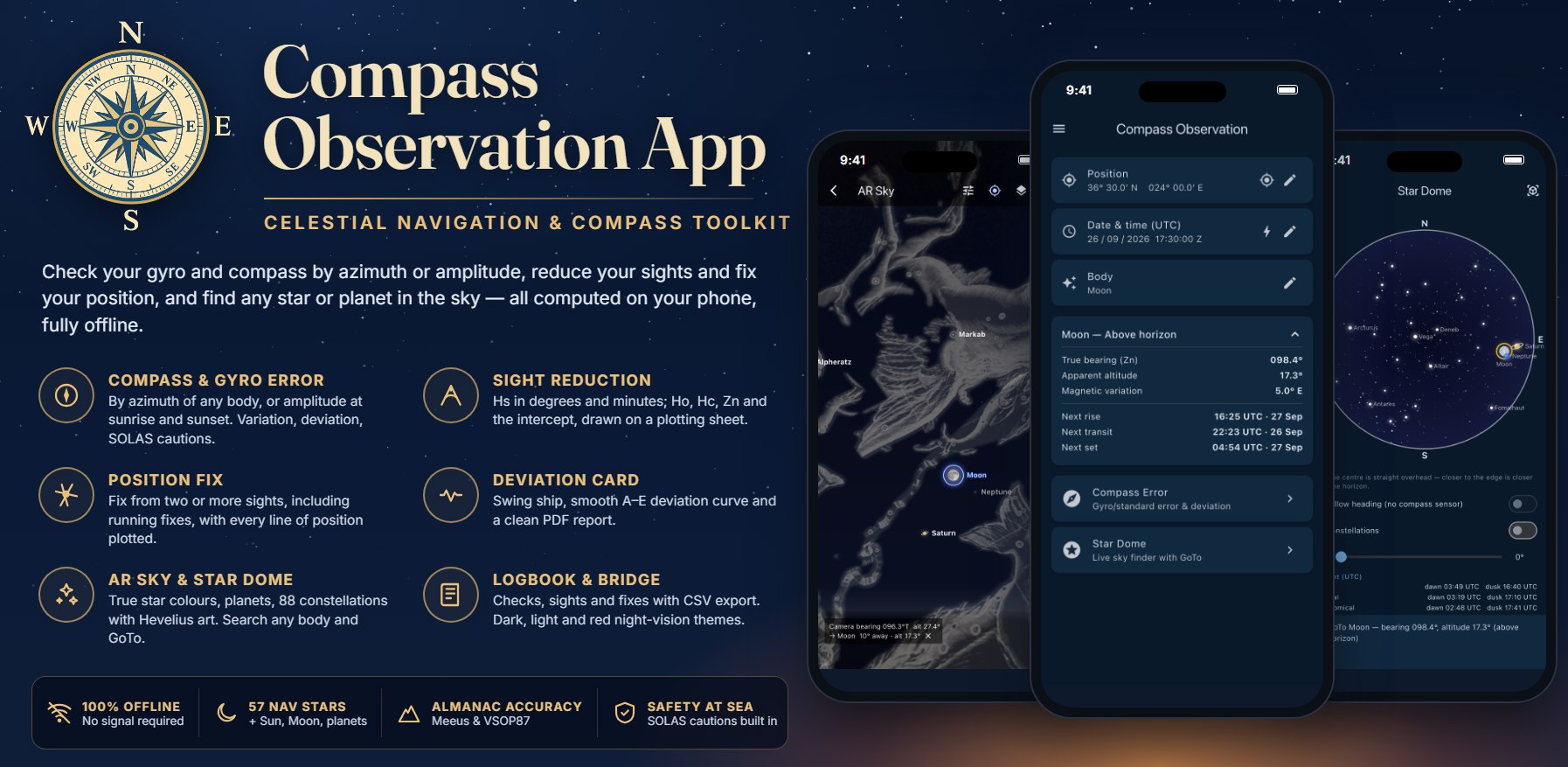
Compass Observation App is a celestial-navigation and compass-checking toolkit for deck officers, watchkeepers, yachtsmen and students of navigation. It turns your position and the UTC time into the true bearings, altitudes and rise/set times of the Sun, Moon, planets and navigational stars — so you can check your gyro and magnetic compass by azimuth or amplitude, reduce your sights and fix your position, build a deviation card, and find your way around the sky.
Everything is computed on the device and works fully offline — no signal required at sea. On Android now, and coming soon to iPhone.
See how it works
Walkthroughs and feature videos, straight from the playlist — search for a topic, or browse with the arrows. New videos appear here as they are added.
Everything a watchkeeper needs
From a single azimuth to a full deviation card — every tool speaks the language of the bridge.
Check gyro & magnetic error
- Work out gyro and magnetic/standard compass error from an azimuth of any celestial body.
- Automatic true bearing, compass error, variation and deviation.
- SOLAS gyro-error and 5° deviation cautions.
- Save readings straight to the logbook or a deviation card.
Compass error at sunrise & sunset
- The classic amplitude check, for the Sun or any body rising or setting.
- The exact true bearing for the Sun’s centre on the visible horizon — dip, refraction and parallax applied — as well as the 0° formula.
- Gyro or standard compass, with SOLAS and deviation cautions.
Intercept method
- Enter the sextant altitude (Hs) in degrees and minutes, as the sextant reads it, with index error, height of eye and limb.
- Refraction for the air temperature and pressure; semi-diameter, parallax and the Moon’s augmentation.
- Observed altitude (Ho), calculated altitude (Hc), azimuth (Zn) and the intercept — toward or away — drawn on a plotting sheet.
Fix from your sights
- Fix your position from two or more saved sights, worked by least squares.
- Running fixes: give the course and speed made good and earlier sights are carried forward.
- Every line of position plotted with the fix and the DR, the largest miss shown; use the fix as your position or log it.
Swing ship
- Record deviation at any heading and build a proper deviation card.
- Smooth deviation curve with A–E coefficients so you can read the deviation at every heading.
- Delete individual readings and export a clean PDF report (vessel, date, adjuster, notes).
The whole sky at a glance
- Live sky chart that rotates with your phone’s compass, with pinch-zoom and manual mode.
- Full star field, accurate Moon phase, twilight times and a “GoTo” pointer for any body.
Point your phone at the sky
- Stars in their true colours, the planets, the Sun and the Moon with its phase, and the Milky Way — over the live camera.
- All 88 constellations, with classic Hevelius (1690) constellation art.
- Search any star, planet or constellation and an arrow leads you to it; double-tap to identify what you’re looking at.
- No camera? A simulated sky and sea. Names stay level however you hold the phone.
Persistent history
- Compass checks, amplitudes, sights and fixes with position, time and headings.
- Export everything to CSV or save to your device.
The whole almanac
- Sun, Moon, Venus, Mars, Jupiter, Saturn and the 57 Nautical-Almanac navigational stars (plus Polaris).
- Rise, set, transit and civil/nautical/astronomical twilight times.
- Magnetic variation from the World Magnetic Model.
Built for the bridge
- Manual position/UTC entry or GPS.
- Light, dark and a red night-vision theme to protect dark adaptation on watch.
Sextant-grade computation
Positions are computed with established astronomical algorithms (Meeus / VSOP87 / ELP-2000), including nutation, aberration, refraction and topocentric parallax — agreement of a few arcseconds for the Sun, planets and stars and sub-arcminute for the Moon, comfortably within sextant precision.